Everything coming at you, in one continuous feed
Your own attack surface, the CVE stream, what you have left exposed in public, and what is being traded in private — watched continuously, correlated, and ranked by what an attacker could actually chain together. A yearly pentest is a snapshot. This does not stop.

Your own attack surface, tested continuously
Every host, port, service and certificate you own, exercised the way an attacker would and re-tested as your estate changes. A vulnerability introduced in a Tuesday deploy is caught that week, not eleven months later at the next audit.
- Servers and services
- Network perimeter
- Web apps, APIs and TLS
New vulnerabilities, matched against what you actually run
Thousands of CVEs are published every month and almost none of them are yours. We match each one against your real inventory and versions, so you hear about the handful that genuinely reach you — ranked by what an attacker could chain together, not by raw CVE count.
- Published CVEs
- Exploit availability
- Your inventory and versions
What you have left in the open without knowing
Attackers start with what is already public. Leaked credentials in breach dumps, keys committed to repositories, forgotten subdomains still answering, and lookalike domains registered against your brand — found the same way, before they are used.
- Leaked credentials
- Exposed keys and repos
- Shadow and lookalike domains
Your name and your data, where they are traded
One of our own cases began with a CERT advisory that a regional OTT platform's user data was for sale on the darknet. Monitoring those markets and forums directly means the first warning comes from us, not from a regulator.
- Marketplace listings
- Forum and channel chatter
- Breach dumps naming you
What actually lands in your hands
Not a score out of ten. Every finding arrives classified, evidenced and actionable — with its OWASP category, its CWE, the CVE where there is one, and the MITRE technique an attacker would use it for.
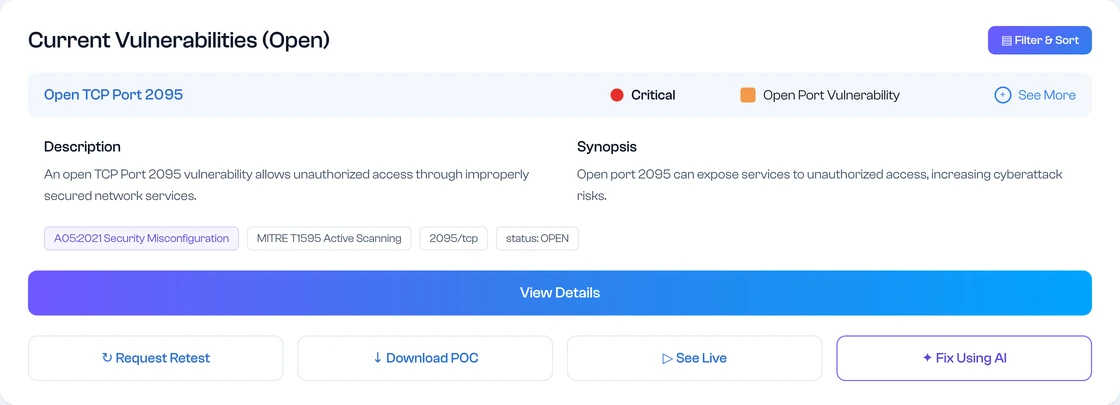
Network scans
Every host, port and service you expose, enumerated with its running software and version — then checked against what is actually exploitable on it.
An open port is not a finding on its own. It becomes one when the service behind it is reachable, out of date, or was never meant to be listening.
Port and service enumeration, version detection, network CVE matching
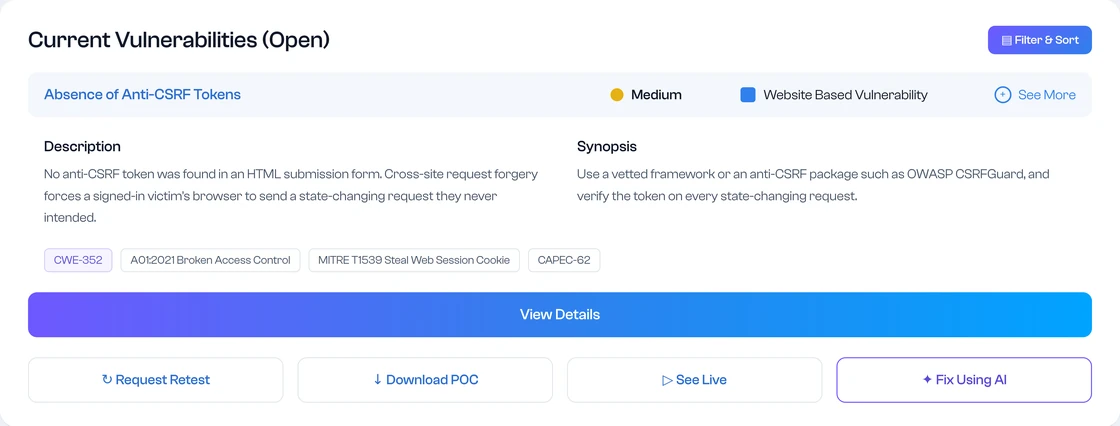
Web application scans
Your application crawled and exercised the way an attacker would: injection, broken access control, session handling, CSRF, and the headers that are supposed to stop all of it.
Passive by default. The active tests that send real payloads run only against assets you have authorised.
Templated and active DAST, endpoint crawling, injection confirmation
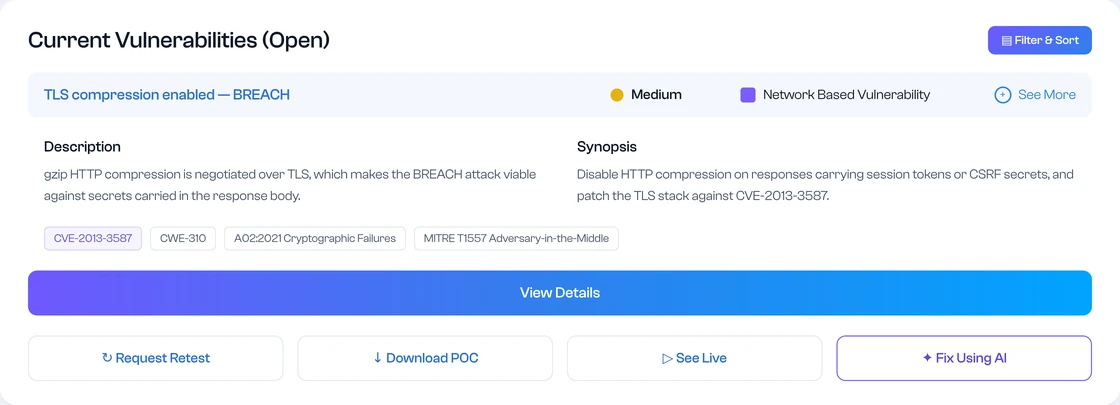
Encryption and TLS scans
Protocols, ciphers, certificates and the named attacks that come with getting them wrong — BREACH, ROBOT, Heartbleed — with the CVE attached to each.
This is the evidence a compliance reviewer asks for, and the part of the estate that expires quietly without anyone noticing.
Full TLS handshake analysis, cipher and certificate audit
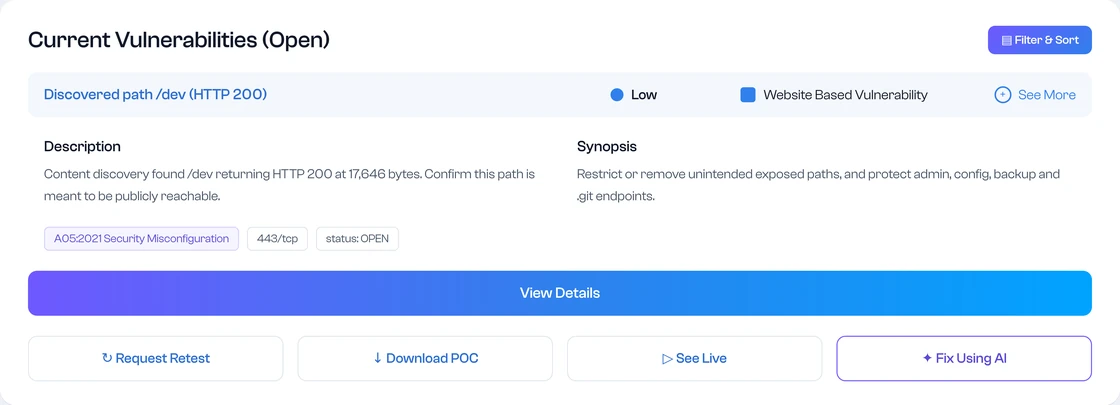
Attack surface discovery
Subdomains, live hosts, forgotten environments and unlinked paths — the things nobody put in the inventory because nobody remembered they were there.
Every host found here becomes a target for the scans above, so the estate you are testing matches the one you actually run.
Passive subdomain enumeration, live-host probing, content discovery