Scam watch
Digital arrest: what the Supreme Court's August 2026 order means for you
· 5 min read
Reviewed by Adv. Mahir Gupta, Advocate, Delhi High Court ·
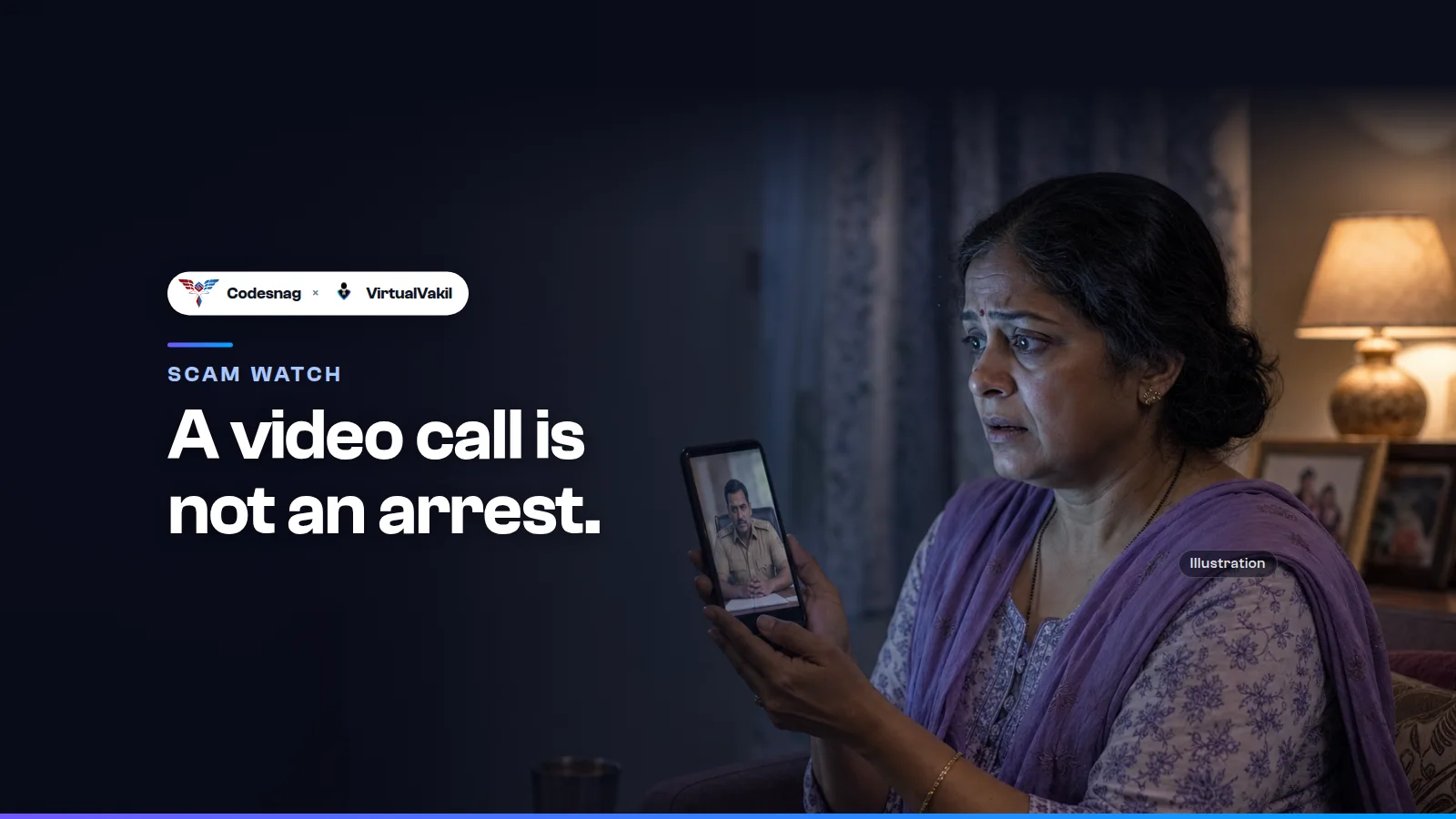
A phone call says a parcel in your name contains drugs, or that your SIM card has been used for money laundering. Within minutes you are on a video call with a person in uniform, told that you are under 'digital arrest' and must not leave the camera. Then comes the demand: move your savings to a 'safe' account for verification. This is the digital arrest scam, and it remains one of the most damaging frauds in India.
The scale is on record. According to a written reply in the Rajya Sabha reported by Inc42, Indians lost Rs 1,935.51 crore to digital arrest scams in 2024, with about 1.23 lakh complaints on the National Cyber Crime Reporting Portal. The Supreme Court took up the issue on its own motion in October 2025, as reported by Verdictum.
On 4 August 2026, the Court issued fresh interim directions on the basis of the fourth status report of the Indian Cyber Crime Coordination Centre (I4C), Ministry of Home Affairs. SCC Online and Verdictum both report that digital arrest complaints fell from 1,23,672 in 2024 to 58,239 in 2025, and to 16,377 up to 30 June 2026. About Rs 18.05 crore has been restored to victims across 36,290 cases.
The same order shows how serious the problem still is. The Court noted that the CBI has registered ten digital arrest cases, and that one investigation alone identified 238 victims, 67 first-layer bank accounts and Rs 80 crore in transactions. The Court directed the Reserve Bank of India to adopt, within four weeks, a standard procedure for banks to place temporary debit holds on accounts linked to mule activity, and directed States to operate cybercrime coordination centres and money restoration modules. A falling number is not a reason to relax.
How the scam works. The caller poses as the police, CBI, customs, the Enforcement Directorate or a judge. The story is built to frighten: a parcel with contraband, a SIM misused for crime, or a relative in custody. The conversation then moves to a video call, often against a backdrop that looks like a police station or court, with a fabricated notice or FIR on screen. The victim is told to stay on camera and to tell no one, so that nobody can interrupt. The money is then taken for 'bail', 'verification' or 'clearance'.
The warning signs are consistent. You are told you are under arrest, but through a call. You are told to stay on video and not to speak to family. You are pressed to act at once. You are asked to transfer money to a 'secure' or 'RBI' account. Genuine agencies do not do any of this. The I4C advisory, reported by the Tribune, is plain: the CBI, police, customs, ED and judges do not arrest you on a video call.
What to do in the first hour. First, end the call and do not return it. Second, call 1930, the national cyber fraud helpline, or file a report at cybercrime.gov.in. If money has moved, say so at once and give the account details, the time and the amount, because speed is what gives the bank a chance to place a hold on the funds. Third, inform your bank and ask it to flag the transaction. Fourth, keep everything: screenshots, call logs, account numbers and the messages. Do not delete the chat, and do not pay any 'release fee' to anyone who offers to recover the money.
Please also be realistic about recovery. Under the RBI's 2017 framework, zero liability applies only to unauthorised transactions reported within three working days; it does not cover payments the victim made themselves, which is how most digital arrest losses occur. RBI has finalised a fraud compensation framework, reported by Business Standard, under which 85 per cent of the loss, capped at Rs 25,000, is payable for losses up to Rs 50,000. It is due to start on 1 January 2027, and it will not make large losses whole. Reporting early is the best protection.
What the law says. 'Digital arrest' is not a named offence; ordinary provisions apply. Impersonating a public servant falls under BNS S. 204, which carries imprisonment of six months to three years and a fine. Extortion, which is putting a person in fear in order to obtain property, falls under BNS S. 308: imprisonment of up to seven years, and up to ten years where the victim is threatened with an accusation of a serious offence (BNS S. 308(2) and S. 308(7)). Cheating is covered by BNS S. 318, and cheating by personation using a computer resource by IT Act S. 66D, with imprisonment of up to three years and a fine of up to Rs 1 lakh. A victim is a complainant, not an accused, and should not be afraid to report.
For families, the most effective step is a simple household rule agreed in advance: no official ever demands money or keeps you on camera, and anyone who receives such a call will hang up and phone a relative. Elderly members, who are the most frequent targets, should know the number 1930 by heart. A five-minute conversation at home costs nothing.
For schools, clinics and small businesses, the same call can arrive at a front desk, and staff who handle accounts should have a written escalation path. Fake notices and spoofed numbers are common, so nobody should act on a call alone. Verify through the official website or the police station directly.
How Codesnag helps. Codesnag and VirtualVakil work on protection and response: checking whether your accounts and devices have been exposed, helping you preserve evidence in the correct order, and guiding you through the first steps of reporting to 1930 and cybercrime.gov.in. We cannot reverse a bank transfer, and the speed of your own report matters more than anything we can add later. If you are in the middle of such a call right now, hang up and dial 1930 first.
Sources
- Verdictum: Supreme Court directs RBI, States and banks to implement urgent SOPs and money restoration measures on digital arrest scams
- SCC Online: SC issues interim directions on digital arrest scams
- Inc42: Indians lost Rs 1,935 crore to digital arrest scams in 2024
- The Tribune: CBI, ED don't arrest via video calls, says I4C advisory
- Drishti Judiciary: Digital Arrest, the modern-day cyber scam
- Business Standard: RBI finalises fraud compensation framework for victims of digital fraud
Need help with a cyber crime? Cyber Surety is a cyber-safety membership by Codesnag × VirtualVakil: ethical hackers and lawyers on your case, 24×7 on WhatsApp. Or read how to file a cyber crime complaint.