Scam watch
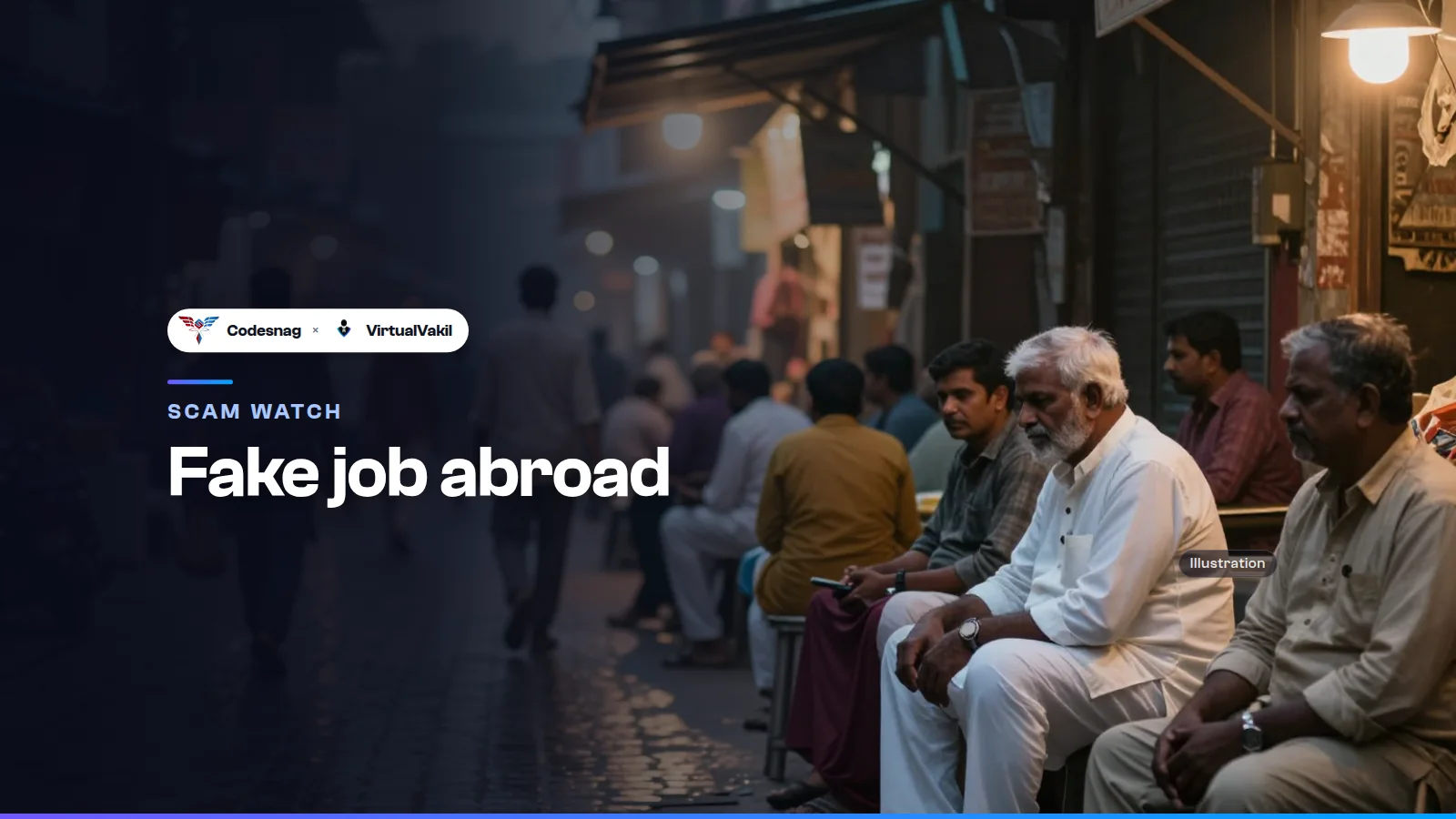
Fake job abroad: how the Bavet scam compound rescue shows the trap
By Adv. Mahir Gupta · · 5 min read
Reviewed by the VirtualVakil legal team ·
In late 2025, 81 Indian nationals were rescued from a scam compound in Bavet, Cambodia, within two days. The Week reported on 2 December 2025 that 28 people were rescued first and 53 more were then located and were being rescued, bringing the total to 81. The rescue began with a distress message posted on social media by two trapped brothers from Uttar Pradesh, which the Indian Embassy in Phnom Penh noticed and followed up. This post is about how such traps are set, because the people most at risk are young job-seekers and their families, who often do not realise anything is wrong until a passport has been taken.
How was the compound found? The Week reports that the Indian Cybercrime Coordination Centre (I4C) of the Ministry of Home Affairs is learnt to have helped locate the building using open-source intelligence, that is, publicly available digital information. The420, describing a later report by the Financial Action Task Force (FATF), gives the same sequence: the embassy identified the message, established contact with those seeking help, asked I4C to pinpoint the location, and Indian officials passed the details to Cambodian authorities. Both outlets describe it as cooperation between the embassy, I4C and the Cambodian government. Neither names the operators of the compound. Both are reports, not official statements, and we have treated them accordingly.
How does the trap work? The420 and a July 2024 analysis by the Observer Research Foundation (ORF) describe a similar pattern. The offer arrives on social media or through an agent, for a well-paid job in customer service, information technology, or digital sales and marketing. The candidate travels abroad. On arrival, the job turns out to be different: the recruit is coerced into running online frauds against people elsewhere, including romance and online gambling scams. The ORF describes victims being held in prison-like conditions and made to repay a so-called debt. The Week's account of the Bavet compound speaks of confinement, threats and fear for safety.
The harm reaches Indian households in two directions. The young person who is trafficked is a victim of forced labour. The people on the other end of the calls are victims of fraud. For the scale of cyber-fraud within India, Ministry of Home Affairs data reported by ThePrint on 21 February 2026 show that Indians lost at least Rs 22,495 crore to cyber fraud in 2025, across 28.15 lakh reported cases, with about 76% of the loss due to investment frauds. We do not claim that all of that originates from such compounds. The point is that the same investment-scam script that traps a worker abroad is used on families here.
Common warning signs include the following. The salary is far above what the role normally pays in India. The recruiter is reached only through social media or messaging apps and offers no registered office. You are asked to pay a fee, or to travel on a tourist visa instead of a work visa. The employer's name or address cannot be independently confirmed. The job is described in vague terms such as customer support, with no written contract and no clear employer. You are told not to discuss the offer with family. Any one of these is reason enough to pause and verify. Several together are serious red flags, and the offer should be treated as a possible trafficking attempt.
Before anyone accepts an overseas job, a few checks are worth the time. Ask for the employer's registered name and a written offer letter, and confirm the company independently through its official channels, not through the number the recruiter supplies. Check whether the recruiting agent is registered. The Ministry of External Affairs website links to the eMigrate portal, which is the place to begin. Tell a family member where you are going and keep a photograph of your passport and visa with them. Never hand over your passport to an agent. If anything feels wrong at the airport or on arrival, contact the Indian embassy or consulate for that country.
What should a family do in the first hour if someone is already stuck? First, save evidence: screenshots of the job advertisement, chats, voice notes, payment receipts, the agent's phone number and any location the person has shared. Do not delete anything. Second, contact the Indian embassy or consulate in that country. In the Bavet case it was the embassy that acted on the public message. Third, report to the police and file a complaint on cybercrime.gov.in. Fourth, if money was paid to the agent or sent under pressure, call 1930, the national cyber-fraud helpline, at once. Speed matters because the quicker a bank is told, the better the chance of tracing the transfer.
If you or a relative has been made to take part in scam calls, act promptly and openly. The420 reports that the FATF findings distinguish between those who direct such enterprises and trafficked workers compelled to participate, so a person found inside a compound may be a victim of trafficking. That distinction does not decide any individual's legal position, which depends on the facts. Tell the embassy and the police at the earliest, give a full and truthful account, and keep every record. Speak to a qualified advocate about your own situation.
What does the law say? Cheating by deception, including a false promise of a job to obtain money, may fall under BNS S. 318. Trafficking of a person for exploitation is dealt with under BNS S. 143. A fake recruiter who took a fee and a network that held the worker abroad may face these provisions, and the facts of each case decide which apply. Reports can be made at the local police station or online, and an FIR is registered under BNSS S. 173. This is general information, not legal advice. For a particular case, speak to a qualified advocate.
How does Codesnag help? For families, our Cyber Surety membership is built around the first hour after something goes wrong: ethical hackers who help you preserve digital evidence and guide you on reporting at 1930 and cybercrime.gov.in. Cyber-loss cover included, up to plan limits. T&C apply. For schools, colleges and employers, we run awareness sessions and phishing drills, because many of these offers arrive by email and WhatsApp to students and staff. You can start with the free breach check on WhatsApp.
The Bavet rescue ended well because someone posted a message, an embassy noticed it, and agencies worked together within days. Most families will not have that chance. The better protection is a habit: when a job abroad sounds too good, pause, verify the employer in writing, check the agent, and tell someone. If a scam has already touched your household, call 1930 first, then file at cybercrime.gov.in.
Sources
- The Week: 81 Indians rescued in India-Cambodia joint cooperation from Bavet scam hub
- The420.in: FATF Reveals How India Tracked Cambodia Scam Compound, Rescued 81 Nationals
- ORF: Robust mechanisms and international collaboration are needed to counter ongoing cybercrimes in Southeast Asia
- ThePrint: Cybercrime saw 24% spike in 2025, Indians lost Rs 22,495 crore, mainly in investment scams
Need help with a cyber crime? Cyber Surety is a cyber-safety membership by Codesnag × VirtualVakil: cyber experts and lawyers on your case, 24×7 on WhatsApp. Or read how to file a cyber crime complaint.