Scam watch
SIM box bust in Bengaluru: how scam calls reach your phone
By Adv. Mahir Gupta · · 5 min read
Reviewed by Adv. Mahir Gupta, Advocate, Delhi High Court ·
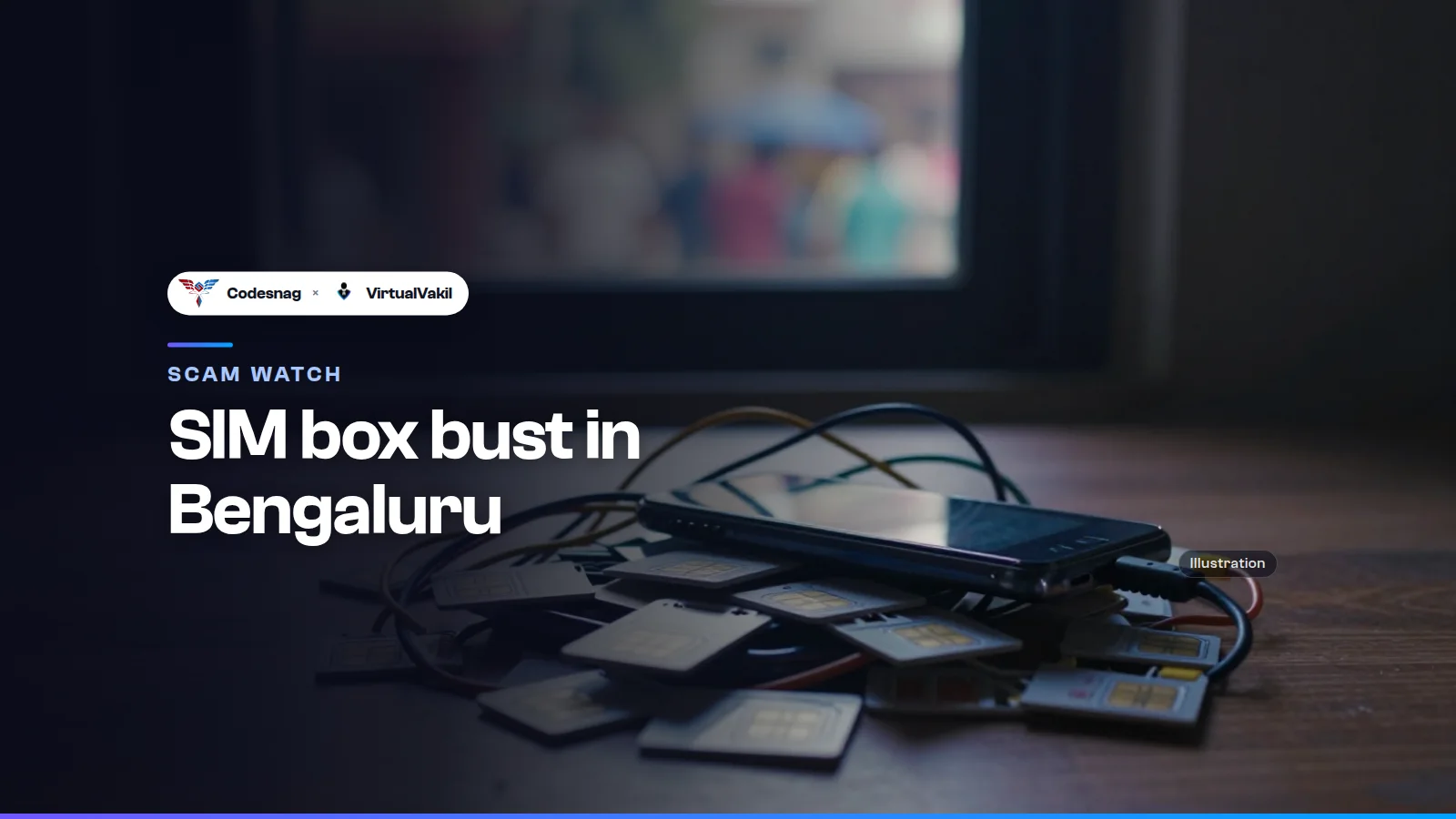
On Thursday, 22 October 2026, the Karnataka Cyber Command announced that it had broken up an illegal SIM box network run from two apartments in Whitefield, Bengaluru, one in Kadugodi and one in Pattandur Agrahara. Police seized 10 SIM box devices. Each device had 32 slots, so the network could hold 320 SIM connections at once.
According to the reports, six devices in Kadugodi carried 192 slots configured with e-SIM connections from various telecom providers. The case was registered on 26 August at the Whitefield Cyber Crime Police Station, after the Chief Circle Nodal Officer of Bharti Airtel complained of suspected unauthorised use of Airtel SIM cards. The Department of Telecommunications (DoT), Karnataka, joined the probe.
Four people from Tiroda in Gondia district, Maharashtra, have been arrested. Police say they are suspected of sourcing SIM cards and converting them into e-SIM profiles for the network. The investigators suspect the network was used in digital-arrest scams, sextortion and other financial cyber frauds across India.
Please note what police have not yet established. Preliminary leads point to financial exposure that could run into hundreds of crores of rupees, but police have said the number of victims, the actual losses and the full extent of the network are still subject to verification. No specific victim or case has been tied to these devices in the reports we reviewed. The accused have been arrested, not convicted.
How does a SIM box help a scammer? A SIM box is a device that holds many SIM cards and lets one operator place or relay a large number of calls and messages through them. For a fraud gang, the value is cover. Calls can appear to come from ordinary Indian mobile numbers and are spread across hundreds of connections, so blocking one number achieves little. Newspapers and police describe this as the infrastructure behind many scam calls; it is not the scam itself.
The scam on your phone is still the old one. A caller claims to be from the CBI, a customs office, a courier company or the police. They say a parcel or an account is linked to a crime, and that you are under 'digital arrest' and must stay on a video call. Digital arrest is not a procedure recognised by any Indian law. Money is then demanded for 'verification' or 'bail'. Scammers using sextortion threaten to circulate private images unless you pay.
Warning signs are consistent. The caller creates panic and urgency. They ask you to stay on the call and tell nobody. They demand a transfer to a 'safe' or 'RBI' account. They send an official-looking notice on WhatsApp. A caller ID that shows an Indian mobile number proves nothing, as SIM box networks of this kind show. Genuine agencies do not interrogate people by video call or take money to close a case.
If you have already paid, treat the first hour as precious. First, stop engaging and end the call. Second, call 1930, the national cybercrime helpline, which is available round the clock, and report the fraud on cybercrime.gov.in. Keep the transaction ID, the time, the account or UPI details, the caller's number and screenshots ready. Third, tell your bank at once. Prompt reporting lets investigators alert banks and collect evidence before it disappears. Fourth, do not delete chats, call logs or recordings.
What does the law say? Obtaining a SIM card through cheating or impersonation, and knowingly possessing a SIM box that uses unauthorised or tampered telecom identifiers, are offences under S. 42 of the Telecommunications Act, 2023 (S. 42(3)(e) and S. 42(3)(f)). The DoT has said that these offences carry up to three years' imprisonment, a fine of up to Rs 50 lakh, or both, that abetment attracts the same punishment, and that the offences are cognizable and non-bailable. Whether any particular charge applies to the Whitefield accused is for the investigation and the court to decide.
For the victim, the fraud itself is dealt with under the Bharatiya Nyaya Sanhita. Cheating that induces someone to hand over money is covered by BNS S. 318(4), which carries imprisonment up to seven years and a fine. Pretending to be an official or another person falls under BNS S. 319 (cheating by personation), with imprisonment up to five years, or a fine, or both. These are summaries of the sections, not legal advice on your case.
Do not lend your identity. The DoT has also cautioned that people who obtain SIM cards in their own name and hand them to others who use them for cyber fraud can be held liable as offenders. Never give your SIM, your Aadhaar-linked documents or your OTP to a stranger offering quick money, however small the favour seems.
Why this matters beyond one city. In a written reply in the Rajya Sabha, the Government reported about 1.23 lakh complaints of digital-arrest frauds on the National Cyber Crime Reporting Portal and losses of about Rs 1,935 crore in 2024, as reported by Inc42. Infrastructure like the Whitefield network is what lets such calls reach families at scale. Catching a few operators does not stop the calls tomorrow, so your own habits remain the first defence.
How Codesnag helps. Codesnag, with VirtualVakil, works on both sides of an incident: protection before it and response after it. For families, that means helping you recognise a scam call, secure your phone and accounts, and preserve evidence in the right order. For schools and small businesses, it means a written response plan: who to call, what to preserve, and who to notify. If you think you have been targeted, report to 1930 and inform your bank first.
Sources
- The South First: Bengaluru cyber police bust SIM box network with suspected links to digital-arrest scams, financial fraud
- Punjab Kesari: Karnataka Cyber Command busts illegal SIM box network in Bengaluru
- IBTimes India: Govt reiterates consequences of IMEI tampering and telecom identifier misuse
- Morung Express (IANS): Govt reiterates consequences of IMEI tampering and telecom identifier misuse
- iPleaders: Section 420 IPC to BNS Section 318 (cheating)
- Vidhi Judicial: Section 318 of the BNS, 2023
- Vidhi Judicial: Section 319 of the BNS, 2023
- Kerala Police: National Cyber Crime Reporting Helpline No 1930
- Inc42: Indians lost Rs 1,935 cr to digital arrest scams in 2024
Need help with a cyber crime? Cyber Surety is a cyber-safety membership by Codesnag × VirtualVakil: cyber experts and lawyers on your case, 24×7 on WhatsApp. Or read how to file a cyber crime complaint.